Scotland’s private renting changes: what tenants need to know in 2026 and beyond
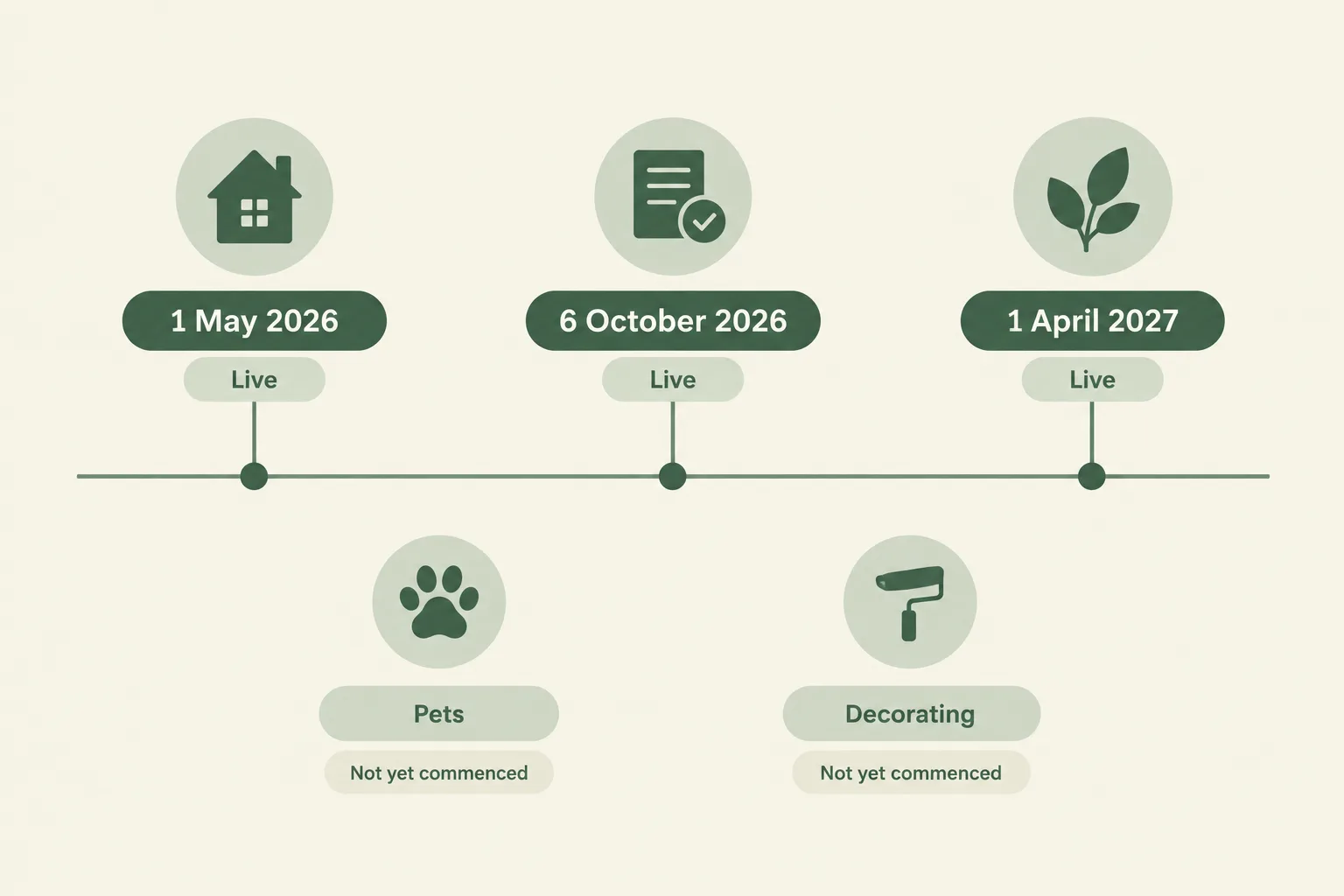
Scotland has several important private renting reforms scheduled or proposed. Some changes start on specific dates in 2026 and 2027, while pet rights, decorating rights, and the first-year rent freeze still need further legislation and have no commencement date yet.
In this article
Scotland’s private renters are facing a mixed picture in 2026: some protections are already in force, while several other changes are announced but not yet live. The practical impact depends on whether you are dealing with discrimination, succession after a tenant’s death, rent reviews, pets, or home improvements.[^1]
For tenants, the key takeaway is that you should not assume every new right is active yet. Some changes have clear commencement dates, while others still need further secondary legislation before they can take effect.[^1]
What is already changing on specific dates
1 May 2026: protection from discrimination based on children or benefits
The Scottish Government says the Renters’ Rights Act 2025 will make it an offence to discriminate against tenants because they have children or receive benefits, with these changes coming into effect on 1 May 2026.[^1]
Tenant impact: if you are applying for a home in Scotland after that date, this should strengthen your position when landlords or letting agents screen applicants. If you are already renting, the practical value is that it should be harder for you to be turned away for those reasons. The source does not explain the enforcement process, so tenants may still need guidance on how to raise a complaint.
6 October 2026: shorter residence period for succession
The same source says that certain household members can already succeed to a Private Residential Tenancy on the death of a tenant if they have lived in the home for a set period, and that from 6 October 2026 the qualifying period will fall from 12 months to 6 months.[^1]
Tenant impact: this is important for households where another person may need to remain in the property if the tenant dies. The shorter period widens the group of people who may qualify to stay, but only from the effective date.
Changes that matter, but are not yet in force
Rent reviews: more time to challenge an increase from 1 April 2027
The Scottish Government says the review process for landlord-proposed rent increases will be improved from 1 April 2027. Tenants will have up to 30 days to apply for a review, and if a Rent Officer or the First-tier Tribunal sets a rent, it cannot be higher than the increase the landlord originally requested.[^1]
Tenant impact: this is a meaningful procedural change. It gives tenants more time to get advice before deciding whether to challenge a rent increase. It also limits the risk of a review resulting in a higher rent than the landlord first asked for.
Pets: a new written-request process, but no start date yet
The source says the Housing (Scotland) Act 2025 gives private tenants the right to make a written request to keep a pet, and landlords cannot unreasonably refuse. However, no commencement date has been set yet, and further secondary legislation is required.[^1]
Under the proposed process, landlords would have to respond within 30 days, could attach reasonable conditions, would need to explain any conditions or refusals, and tenants could challenge an unreasonable refusal or condition at the First-tier Tribunal (Housing and Property Chamber).[^1]
Tenant impact: this could become a major quality-of-life improvement, but as of the evidence date it is not yet a live right. Tenants should still check their tenancy agreement and ask permission in writing if they want to keep a pet.
Decorating and personalising: limited changes after 6 months, but still not in force
The same source says the Housing (Scotland) Act 2025 will give private tenants greater rights to personalise and decorate after living in the property for 6 months.[^1]
The planned model has two categories:
- Category 1: minor changes tenants can make without consent, such as posters or pictures
- Category 2: larger changes tenants can request, such as painting walls or putting up shelves, and these cannot be unreasonably refused[^1]
For Category 2 changes, tenants would need to have lived in the property for 6 months, the landlord would have 30 days to respond, and any refusal or conditions must be explained. Tenants would be able to challenge unreasonable decisions at the First-tier Tribunal (Housing and Property Chamber).[^1]
Tenant impact: if these rules come into force as described, they would reduce the current “ask first for everything” approach. But at present, the source is clear that no start date has been set and further regulations are needed.[^1]
No rent increase in the first 12 months: still pending
The source also says the Housing (Scotland) Act 2025 will ensure rents cannot be increased within the first 12 months of a private residential tenancy, but again no date has been set.[^1]
Tenant impact: this would be a major change for new lets, but tenants should not treat it as current law yet.
Practical checklist for tenants
If you are renting in Scotland, this is the safest way to respond to these changes:
- Check the date first. Some protections are effective on specific dates; others are not yet in force.[^1]
- Put requests in writing. That is already essential for pet and decoration changes under the new framework described by the Scottish Government.[^1]
- Keep evidence. Save emails, messages, and tenancy paperwork in case you need to challenge a refusal or rent increase.
- Ask whether the new rule is live. A landlord may be following an announced reform before it starts, or may still be using the current law.
- Get advice quickly if you receive a rent increase. The new 30-day review window is not yet live until 1 April 2027, but it signals that rent challenges are time-sensitive.[^1]
Should an existing guide be updated?
Yes — the most obvious update is to the tenant FAQ. It should include a Scotland-specific section covering:
- the 1 May 2026 discrimination offence for tenants with children or receiving benefits
- the 6 October 2026 succession change
- the 1 April 2027 rent review timetable
- the fact that pet and decoration rights are announced but not yet commenced[^1]
A short cross-link from the moving-in checklist could also be useful, especially for tenants who want to know what they can ask for before or after move-in.
Bottom line
The headline for Scotland’s private renters is encouraging, but timing matters. Some protections are already scheduled with clear commencement dates, while others are still proposals pending further regulations. For now, tenants should treat pets, decorating, and the first-year rent freeze as future rights, not current ones, unless and until the law starts in force.[^1]